Assessing Iron Nitride Magnet Performance Through Joint Development
Simulation-to-Test Correlation for Rare-Earth-Free Motor Technology
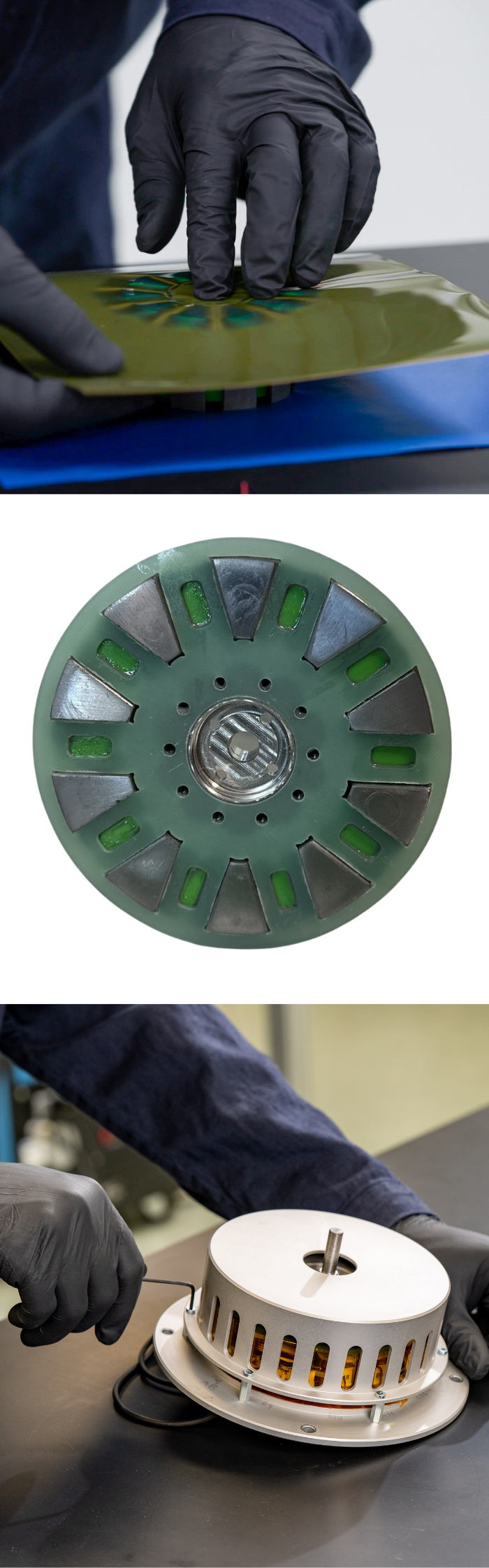
Alvier collaborated with Niron Magnetics on a development project to evaluate the feasibility of using Niron's rare-earth-free Iron Nitride magnet technology within an axial flux electric motor prototype. The project aimed to understand how market-entry performance Iron Nitride materials behave under real world electromagnetic and mechanical operating conditions and to assess how simulation models align with measured performance. The work contributes to broader industry efforts to diversify magnet materials and expand options for rare-earth-free electric drive technologies.
As part of the study, Alvier designed, built, and tested a prototype motor incorporating Iron Nitride magnets and soft magnetic composite (SMC) components. The project combined electromagnetic simulation, mechanical analysis, and physical testing to evaluate the torque, output power, efficiency, and structural integrity at operating speeds up to 6,000 rpm. The simulations and measurements showed close correlation across the tested range, demonstrating that the modelling approach can effectively support future optimisation studies.
A key outcome of the simulation phase of the project was a clearer understanding of how Iron Nitride magnets perform in assembled motor environments. Mechanical simulations provided insight into stress levels, deformation, and safety factors for components such as adhesives, rotor structures, and SMC pole pieces, informing considerations for future design iterations.
| Theme | Evaluation Area | Outcome | Sustainability Relevance |
|---|---|---|---|
| Material Innovation | Iron Nitride Magnet Feasibility | Under active evaluation; early-stage results promising for further study | Supports diversification of magnet supply chains and potential reduction of reliance on rare earth elements |
| Material Behaviour in Motor Assembly | Able within tested conditions | Supports assessment of long-term suitability of alternative magnet chemistries | |
| Testing, Integrity & Validation | Simulation-to-Test Correlation | Good agreement observed across the tested range | Strengthens confidence in predictive tools used to avoid unnecessary prototypes |
| Electromagnetic Characterisation | Qualitative performance aligned with expected trends | Ensures data-driven evaluation without overstated environmental claims | |
| Mechanical Verification | All major components within modelled qualitative safety margins | Supports safe integration of new materials without compromising reliability | |
| Circularity & Resource Efficiency | Prototype Reusability Insights | Components retained integrity for further evaluation | Reduces waste by enabling extended testing cycles |
| Material Recovery Considerations | Preliminary pathways identified for future study | Encourages long-term thinking about end-of-life handling for new magnet materials | |
| Capability Building | Modelling & Simulation Expertise | Enhanced ability to model emerging magnet types | Strengthens internal engineering capability for sustainable design |
| Collaboration & Knowledge Sharing | Joint insights inform future development phases | Builds cross-industry understanding necessary for transitioning to alternative materials | |
| Strategic Outlook | Application Suitability | Further investigations planned based on initial learnings | Positions Alvier to evaluate low-impact magnet solutions as they mature |