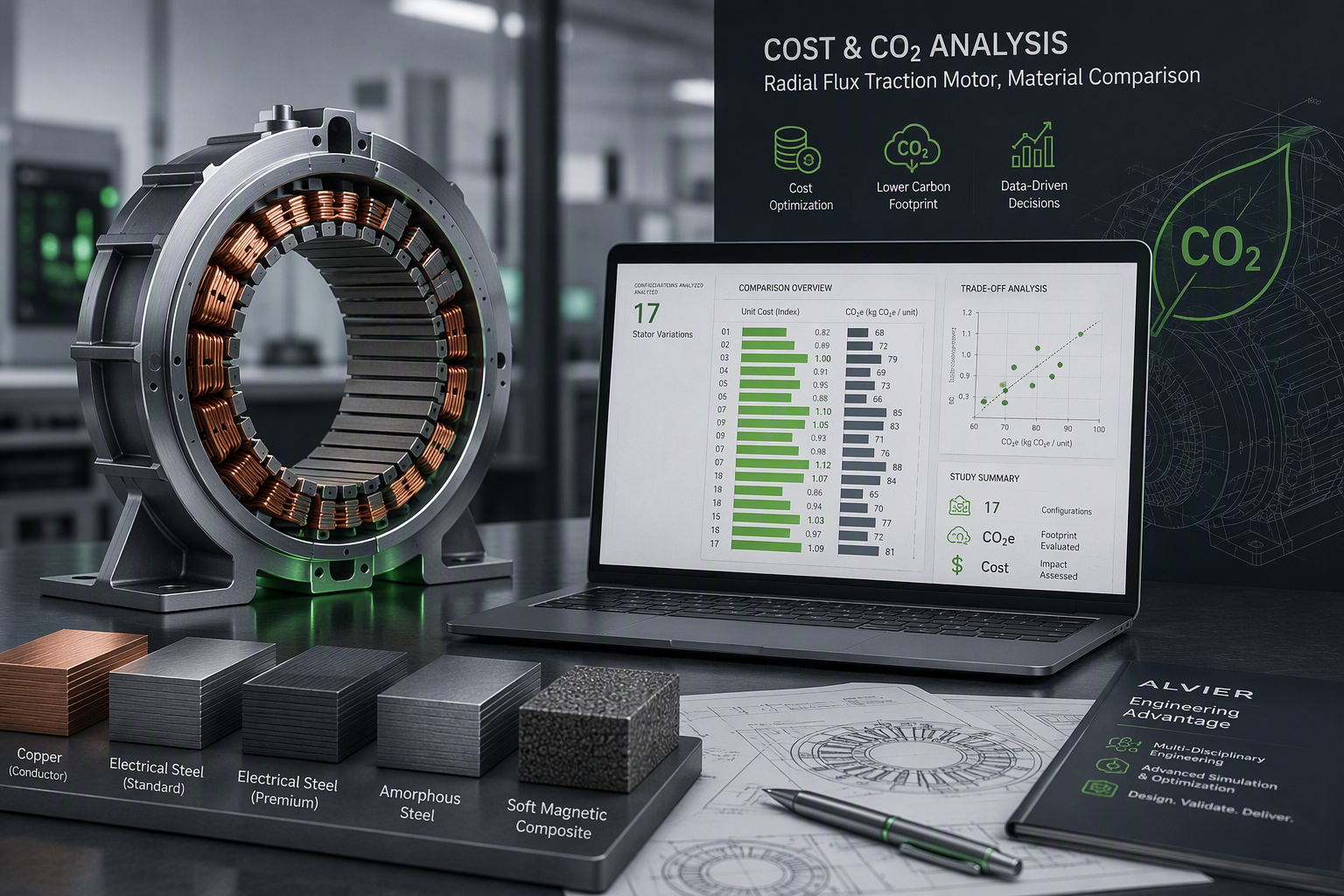
Alvier helps you understand the financial and environmental impact of your designs.
Our PxC software calculates component costs and CO₂ emissions efficiently, using customizable material and machine databases.
Available as a standalone analysis or integrated with design/prototype packages.
Databases can be adjusted to reflect customer-specific costs or emissions factors.
All cost models, CO₂ analyses, and study outputs belong to you. We generate insights that become your competitive advantage.
Make data-driven decisions to optimise cost, reduce carbon footprint, and improve sustainability, without wasting time searching through complex software.
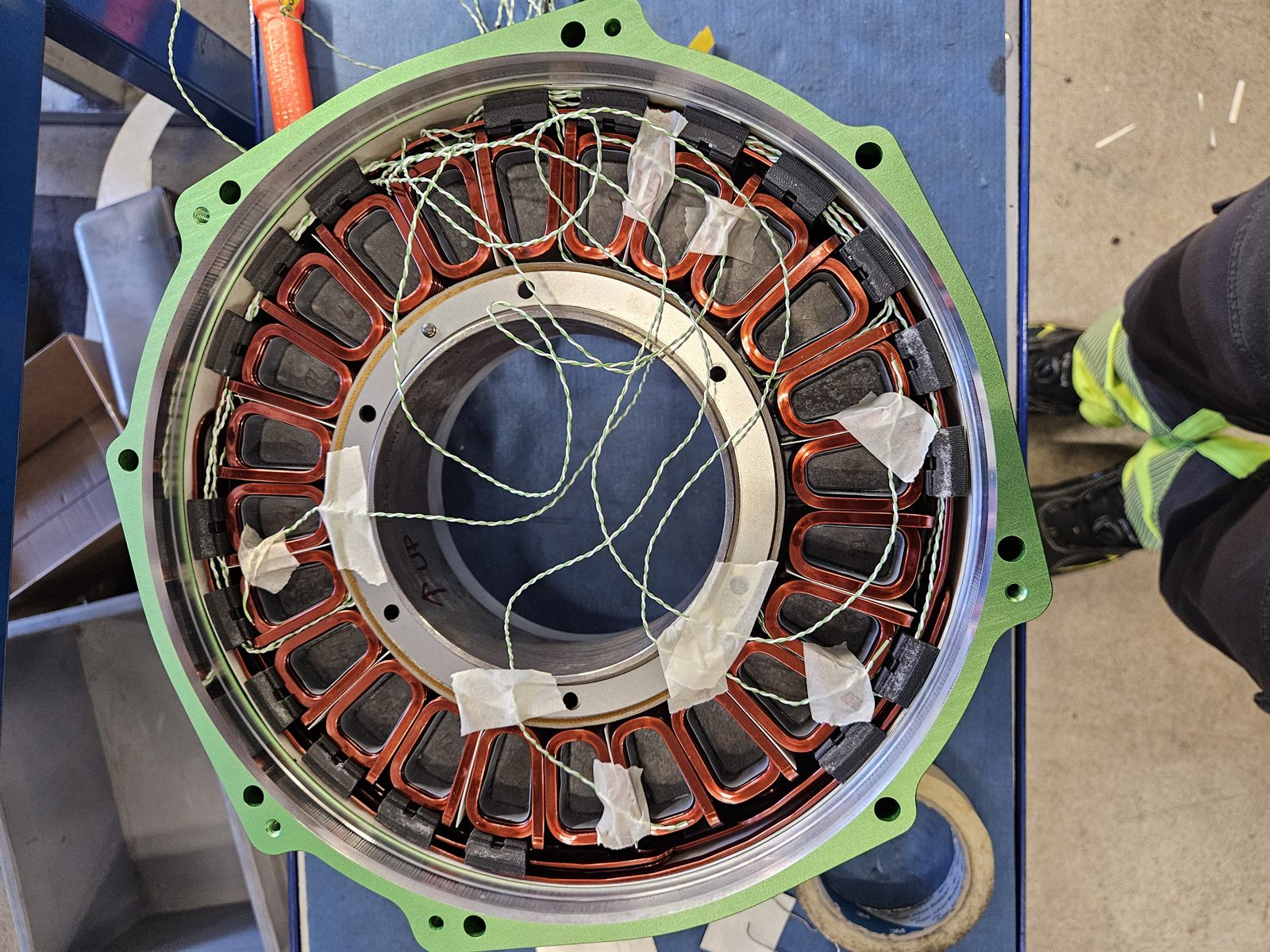
Alvier performed cost and CO₂ emissions calculations alongside an internal teardown investigation of a new traction electric machine system and its predecessor. The study compared three configurations across two companies, an axial flux machine (AFM) and two radial flux machines (RFM), evaluating stator and rotor materials including SMC, LSS grades M270-27A and NO20-13.
| Configuration | Motor Type | Stator Material | CO₂ Ranking | Cost Ranking |
|---|---|---|---|---|
| Company A | AFM (Axial Flux) | SMC | 1st | 2nd |
| Company B, Predecessor | RFM (Radial Flux) | LSS M270-27A | 2nd | 1st |
| Company B, New Version | RFM (Radial Flux) | LSS NO20-13 | 3rd | 3rd |
AFM = Axial Flux Machine, RFM = Radial Flux Machine, SMC = Soft Magnetic Composite, LSS = Laminated Steel Sheet
Company A's AFM with SMC stator achieved the lowest CO₂ footprint. Company B's new RFM version was ~10% more expensive than its predecessor and had ~30% higher kg CO₂e than Company A's AFM, reflecting the cost of higher-performance materials and annealing processes.
Key insight: Material and topology choices have a significant and measurable impact on both cost and CO₂ footprint, data-driven decisions at the design stage can reduce both.
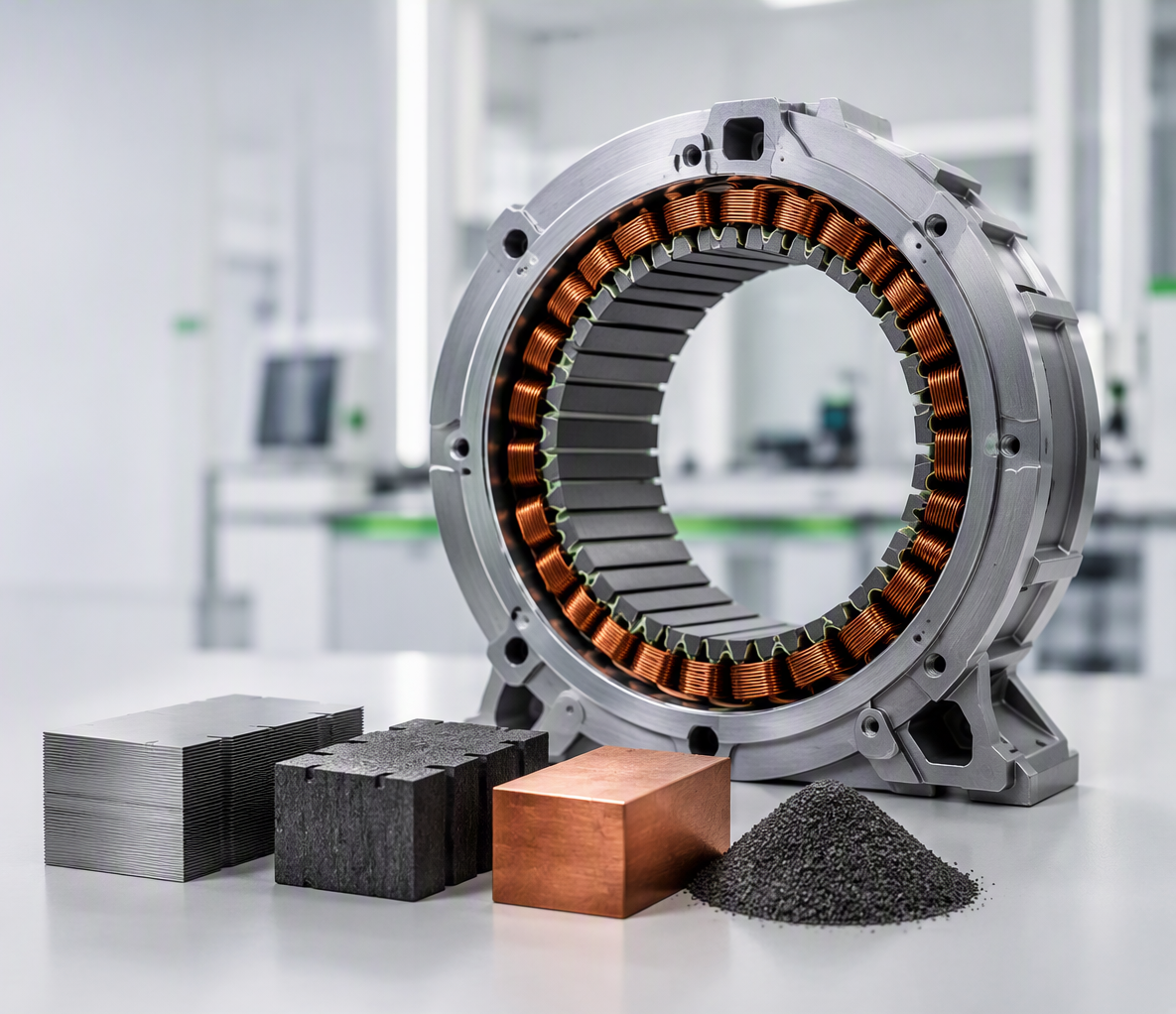
For one customer, a costing and CO₂ study was performed on multiple variations of materials and size configurations of electric machines based on a radial flux traction motor design developed by Alvier. Seventeen configurations were calculated, comparing only the stator component. By varying stator materials, outer diameter, or compaction press sizes, differences in unit cost and investment were identified.
Key insight: The study provided critical data on how material choices impact cost and CO₂ footprint alongside performance and efficiency.
Optimise complete electric drive systems for performance, cost, weight, efficiency, and durability.
Learn More →Electromagnetic, thermal, and mechanical simulations ensuring precision from feasibility to detailed design.
Learn More →In-depth analysis of existing machines: teardowns, measurement, magnetic characterisation, and digital twins.
Learn More →