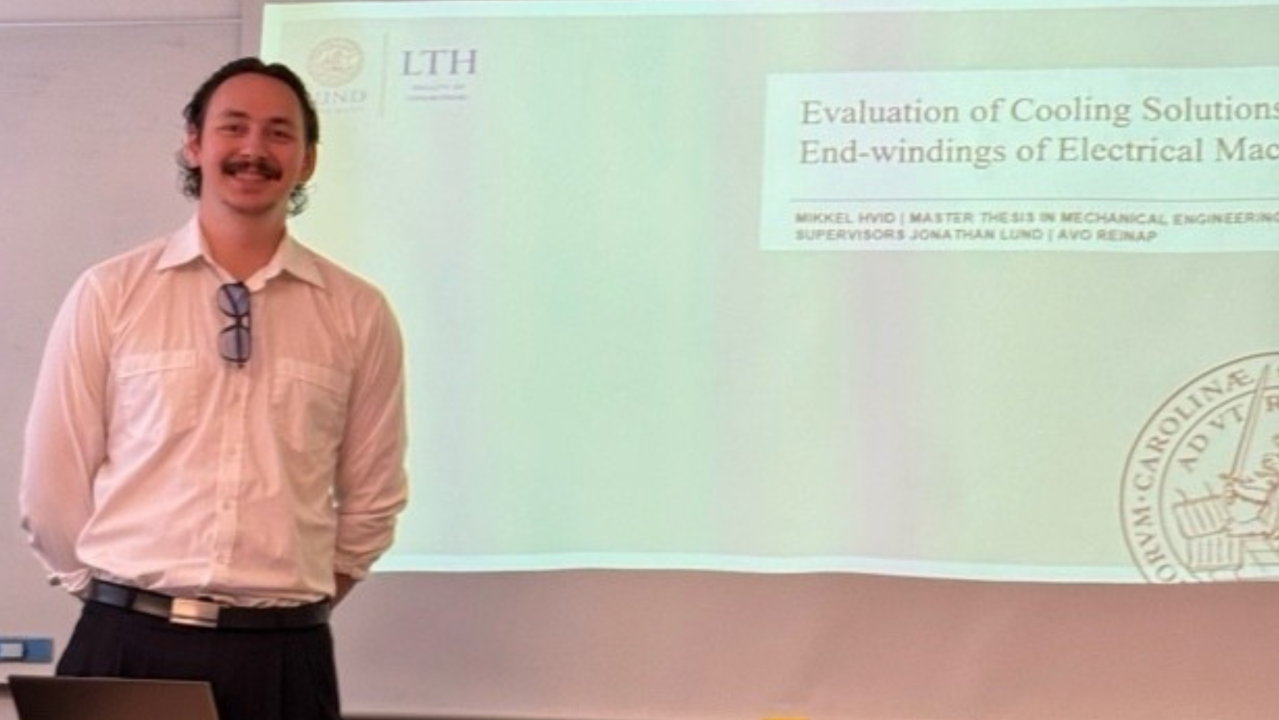
At Alvier, we run regular Friday seminars, short internal sessions where engineers, customers, partners and students share ongoing work and technical learnings. In our latest session, Mikkel Hvid presented his master thesis carried out at Alvier, giving the team a deep dive into his work on electric motor cooling.
Mikkel is currently completing his Master of Science in Mechanical Engineering at Lund University, with a focus on thermal management in electric machines. We spoke with him after the seminar.
Can you briefly introduce yourself and your background?
I'm studying Mechanical Engineering at Lund University, and my thesis focuses on cooling of electric motors, specifically the thermal behaviour of the end windings.
What was the main focus of your Master thesis at Alvier?
The work focused on developing alternative cooling concepts for electric motor end windings. These are often a thermal bottleneck and can limit performance. One of the main motivations was to reduce reliance on oil-based cooling systems. While effective, they introduce complexity in terms of specialised fluids, sealing, filtration, and system robustness. The goal was therefore to explore water-based cooling solutions that are scalable and can be integrated into existing motor designs without compromising performance.
How did you approach the problem?
I started by building and validating a thermal model in MotorCAD, based on a reference motor. This allowed me to perform parameter studies and sensitivity analysis to understand which variables have the greatest influence on cooling performance. From there, the work combined thermal modelling and parameter sweeps, concept generation and screening, multiphysics simulation in COMSOL, and experimental validation.
What were the key technical insights from your work?
One important finding was that increasing coolant flow rate improves cooling performance initially, but with diminishing returns, as the coolant approaches thermal equilibrium. Another key insight was that local heat extraction at the end windings plays a critical role, and in some cases has a larger impact than further optimising the external cooling system.
What solution did you develop?
The most promising concept was a hybrid cooling approach combining potting with a high thermal conductive network based on heat pipes. The design focuses on creating efficient thermal pathways between the end windings and the cooling structure, segmenting the conductive network to reduce AC losses and ensuring good mechanical contact while remaining scalable for different motor geometries.
How did it perform?
Both simulation and experimental testing showed that this approach can significantly improve cooling compared to air cooling or conventional potting alone. Key observations: increasing the number of heat pipe layers had a stronger impact on temperature reduction than increasing geometry length; contact quality and manufacturing tolerances can strongly influence performance; there are clear trade-offs between cooling performance, pressure losses, and system cost.
What are the next steps for the concept?
The next step is to validate the concept at full motor scale and further investigate AC-related losses and electromagnetic effects, manufacturing methods and integration challenges, and the cost-performance balance compared to high-performance potting materials.
What was your experience of working at Alvier?
It was very hands-on. I could move between simulation, concept development and physical testing, which gave a much better understanding of the problem. There was also a lot of technical discussion with the team, which helped refine both the concepts and the analysis.
What would you say to students considering a Master thesis at Alvier?
If you want to work on real engineering challenges and combine theory with practical work, it's a great environment. You get responsibility, but also strong support from experienced engineers and industry supervisors.
At Alvier, thesis projects are closely connected to ongoing development work. It's not just about completing a thesis, but about exploring ideas that can move towards real applications. If you're interested in doing your master thesis or gaining hands-on experience in electric machine development, visit our careers page.
Interested in a thesis or internship at Alvier?
View Careers