Case Study
Niron Magnetics: Rare-Earth-Free Motor Development
Development of an automotive traction motor using Iron Nitride magnets as an alternative to rare-earth materials
Get in Touch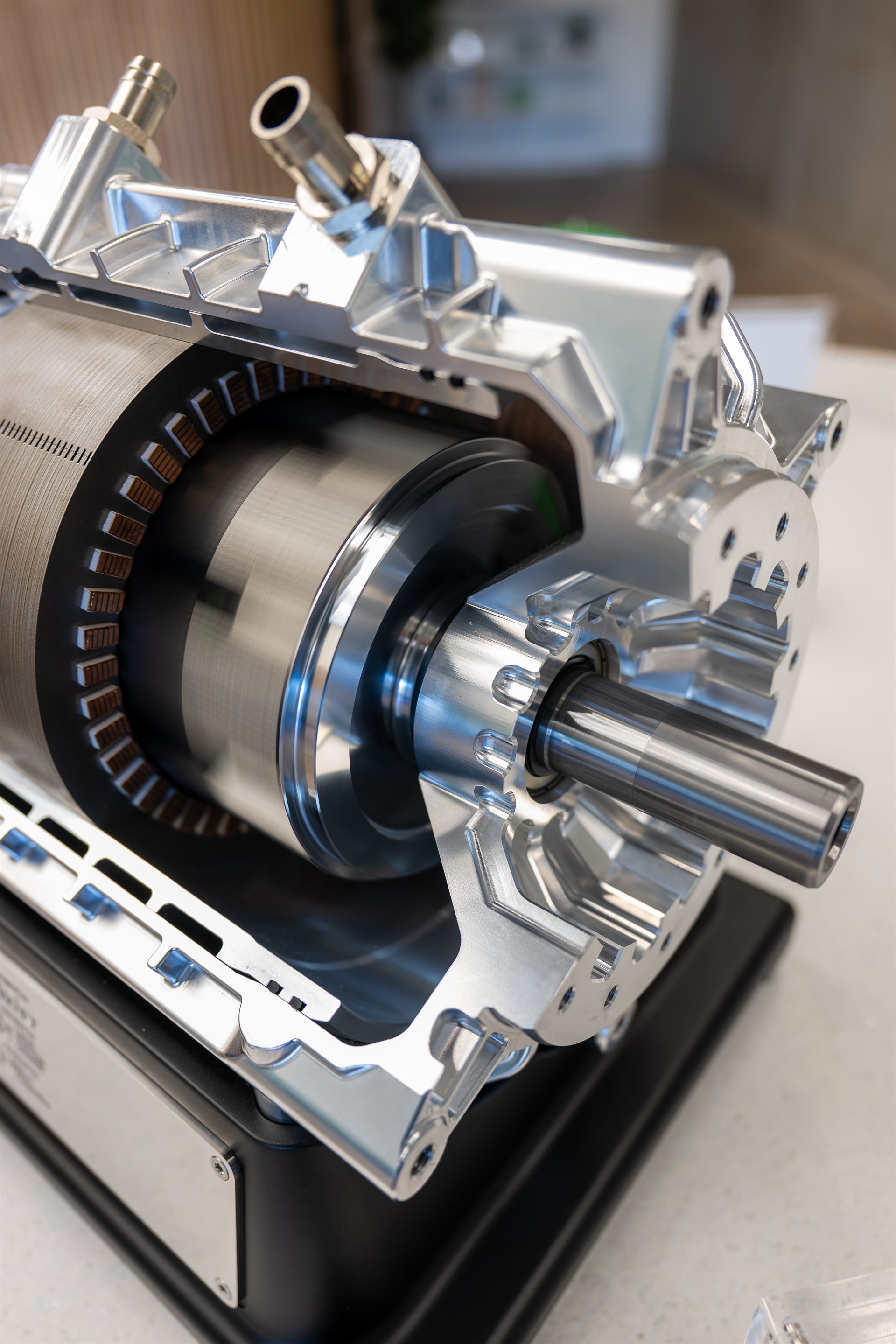
Development of an automotive traction motor using Iron Nitride magnets as an alternative to rare-earth materials
Get in Touch
As the electrification market matured, motor design was increasingly shaped by more than torque, power and efficiency alone. Supply-chain resilience, material availability, sustainability, cost volatility and regulatory pressure became part of the engineering brief. In automotive traction applications, this created a clear question: what would change when a motor is not designed around the properties of conventional rare-earth magnets that were initially developed by General Motors and Sumitomo Special Metals in the 1980s?
Together with Niron Magnetics, Alvier explored this question through the Niron Magnetics VFI project: a traction machine concept developed to evaluate the suitability of Niron Magnetics' Iron Nitride (FeN) magnets in a Variable Flux, Flux Intensifying (VFI) machine. The project's objective was to demonstrate the suitability of FeN magnets for automotive traction using VFI technology.
Rather than treating FeN as a simple drop-in replacement for Neodymium-Iron-Boron (NdFeB) magnets, the project approached the material as a design input in its own right. FeN magnets are rare-earth-free and offer properties including high remanence, low thermal coefficients, and high-temperature operating capability, with moderate coercive force. Their electrical resistivity is also substantially higher than that of NdFeB and Samarium Cobalt (SmCo) magnets.
The driving factors behind this shift included:
The project began with a structured concept selection phase and moved into detailed design, covering electromagnetic, mechanical and manufacturing considerations:
Multiple VFI topologies were reviewed and modelled against key criteria including torque and power potential, efficiency, structural integrity, controllability, thermal behaviour, cost and magnetisation feasibility.
Alvier refined the electromagnetic and mechanical models, aligned the geometry with supplier-approved documentation, updated material definitions, evaluated winding configuration, and released drawings and specifications for manufacturing. The detailed design phase was completed and all drawings and specifications were released.
FeN magnets offer moderate coercivity, resilience to temperature changes and elevated temperatures, and higher electrical resistivity than NdFeB and Samarium Cobalt magnets. These properties were treated as design inputs rather than constraints.
Winding configuration was evaluated as part of the detailed design, ensuring compatibility with the selected topology and the performance requirements for automotive traction applications.
Instead of operating with one fixed magnetisation state throughout the machine's life, the VFI is based on the concept of dynamically adjusting the magnetisation states based on the speed and torque operating points of the motor. This provides a way to optimise performance and efficiency by selecting the optimal magnetisation state during operation.
In simulations run under identical inputs and boundary conditions, the VFI motor achieved higher duty cycle efficiency than the Volkswagen APP550 reference motor on both the Worldwide Harmonized Light Vehicles Test Cycle (WLTC) and the Highway Fuel Economy Test (HWFET).
Simulations showed that the machine could produce more than 300 Nm peak torque at full magnetisation while leveraging the flux intensification concept.
The project demonstrated what it meant to engineer around a material, not simply specify one. It brought together motor architecture, electromagnetic simulation, mechanical design, manufacturability, control strategy and prototype preparation into one development path.
By building on the fundamentals of electromagnetics rather than conventional motor design principles, the VFI project shows that competitive motor performance is achievable using the unique properties of FeN magnets. Continued optimisation and material development will advance this technology and open new opportunities.